An Unusual Hunter
Tractable pigs and binary confounding companions
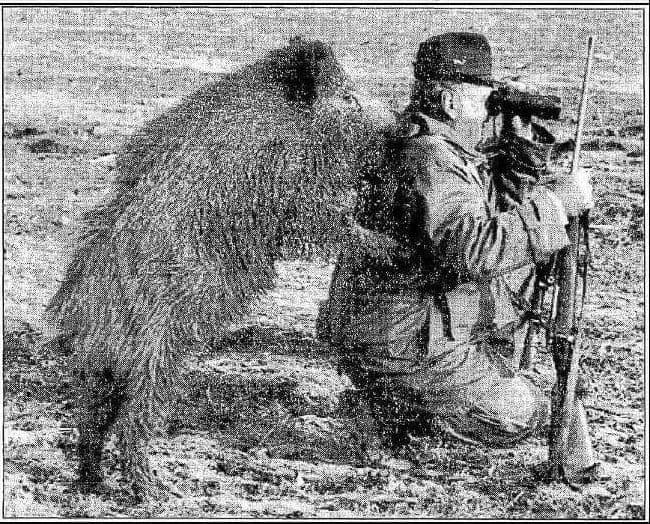
Hungarian pig hunter, Janosz Vincza and 9 month old boar, wild caught and hand-raised, with an "excellent nose and points to game he has scented by raising his bristles and his tail" [Canberra Times (ACT : 1926 - 1995), Saturday 13 March 1993, page 15].
People can often be surprised at the tractability of pigs - the ability to train them to perform various tasks.
For instance, the story of a pig called “Slut” appeared to have captured the imaginations of some Europeans in the mid-19th century, a surprise partly due to the general low opinion of pigs and the rare cases in which they were worked with and kept for reasons beyond consumption.
The curiosity with Slut lay in that she was performing a role and relationship to game many thought only possible with dogs. She was trained to track and point at pheasants, and even work in a multispecies tracking team along with dogs (who seemed somewhat reticent to work with this lowly pig!). A rich description of Slut, her skills, and ultimately her demise can be found on page 25 of The Pig. A Treatise on the Breeds, Management, Feeding, and Medical Treatment, of Swine; with Directions for Salting Pork, and Curing Bacon and Hams by William Youatt, 1847, or read on the website Dogwilling which has some lovely accompanying images.
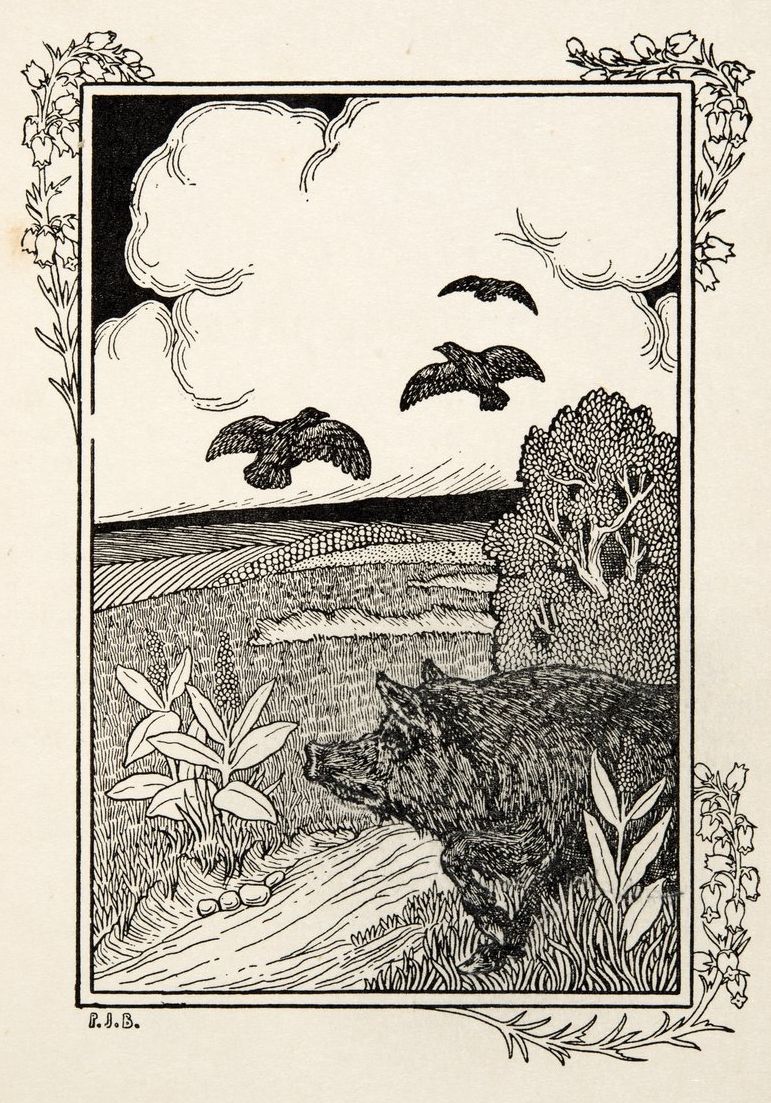
The Pig Pointer (1924) (Engraving: Percy J. Billingshurst)
Interestingly, Marcy Horton in her 2015 historical anthropological article The Chicken or the Iegue: Human-Animal Relationships and the Columbian Exchange opens the piece with a 16th century document of a Ta'ino man - a people indigenous to the Caribbean, who hunted pigs with pigs. Part of the paragraph is quoted below.
In 1543, a Ta´ino man had been living in the mountains in the central southern part of Hispaniola for twelve years. Though fluent in Spanish and familiar with Spanish ways, he had fled to escape the oppressive exploitation of the encomienda. The man survived in the wilderness through a special relationship with three formerly feral pigs, two males and a female. The man and his pigs would go hunting for “wild” pigs, in the same way Europeans hunted prey with dogs—one pig tracking, one seizing, and one assisting, with the Indian giving the final thrust of death with a make-do spear. Once the prey was killed, the man would preside over the ritual distribution of the carcass, as was done in traditional hunts in Europe with dogs, “giving the interior parts to his companions,” while he made a barbecue for himself and salted the flesh for several days’ consumption. When prey was not readily available, the man also foraged for roots and plants, which he ate and shared with his porcine company. “At night,” wrote the conquistador-turned-chronicler Gonzalo Ferna´ndez de Oviedo, “the said Indian went to bed among that bestial company, petting for hours one and then the other, devoted to the swine [la porcesa].”
Tragedy ensued, however, when the pigs were spotted by several Spanish soldiers who were in the mountains looking for runaway slaves after a recent rebellion. Assuming that these were feral pigs who roamed the countryside rather than the property of an individual, the soldiers slaughtered them. Bereft over their loss, the man told the three soldiers, “Those pigs gave me life and maintained me as I maintained them; they were my friends and good company; one I gave this name, and the other was called so-and-so, and the female pig was called so-and-so.”
As Horton argues, the colonial European's fascination and repulsion with this interspecies relation was for two related reasons. First, they had difficulty understanding why a human would choose to live among and so intimately with beasts, both tame and wild (note that he even rootled collaboratively with pigs!).
Second, the man successfully confounded taxonomic categories by using the "lowliest of livestock" as an animal for labour and hunting (a category usually confined to dogs, horses, and hunting raptors). The same tensions found in the account of Slut above. However, the indigenous person was less concerned with differences between human and animal, hunting animal and livestock, and** more concerned about negotiating the dividing line between wild and tame, and successfully transforming "enemies into kin,** [or] prey into 'pets'"(p. 29, Horton 2015) - a common theme among South American indigenous peoples.
I might add a third fascination - that the pigs by becoming kin with a human, had learned to hunt their own kind.
Note that the first pigs introduced to the America's were in the 16th century on the Carribean islands.