“Honorary Wild Boar”
An essay by André Thiemann
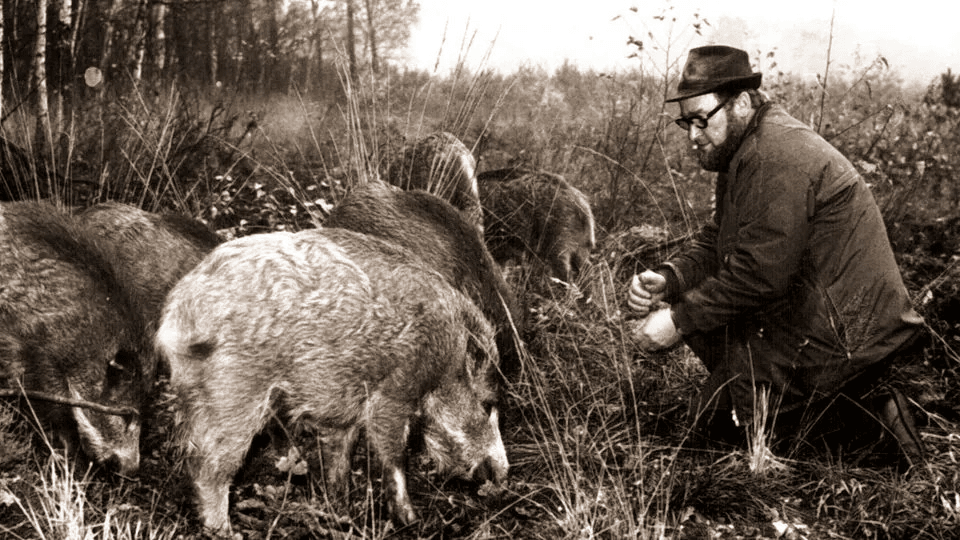
Biologist and documentary filmmaker Heinz Meynhardt observes “his” boar sounder feeding (© MDR.DE).
Pigs can be exciting companions and some humans dedicate their lives to understanding them. So did Heinz Meynhardt – known across Germany as the “honorary wild boar” (“Wildschwein ehrenhalber”) and to close friends as “swine-Meynhardt” (Schweine-Meynhardt). “Honorary wild boar” was the title of three documentary films on his adventures with a sounder that aired on East German television in 1977-78. Meynhardt had followed the sounder daily for years, and continued to document its generational successions, splits and reunions for a dozen more years (see trailer: Heinz Meynhardt in freier Wildbahn). At least once he saved “his” sounder (he had been accepted as its matriarch) by secretly leading it out of the forest where his human friends – the hunters of Burg near Madgeburg – planned to hunt that day.
After almost two decades of work with wild boar, Heinz died in late 1989, aged only 54, just as the “wind of change” swept across Eastern Europe and heralded the end of the GDR. Like many East German achievements, my generation (I was born in 1977) largely forgot Meynhardt’s work, although before 1989 we must have watched countless times his altogether 32 documentaries, and devoured his children’s books Das Jahr der Wildschweine, Graubart. Ein Tag im Leben eines Wildschweins, and Wildschweingeschichten. I only rediscovered Heinz Meynhardt through a side note in Thomas Fleischman’s (2020) Communist Pigs: An Animal History of East Germany’s Rise and Fall.
Meynhardt was born in 1935 and worked with animals his entire life, successfully raising budgies and parrots, as well as bull terriers as hunting dogs. He was also fascinated by wild life documentaries early on. As self-employed master electrician, he equipped himself with a camera and recording gear and documented several species such as moorhen in the Danube delta (Romania). Being also a hunter, he participated in distraction feeding of wild boar – a tactical feeding to keep the animals away from the field in critical moments such as after planting, which brought him into very close contact with a sounder. He became the first human who was ever allowed by a sow to stay nearby and film as she gave birth.
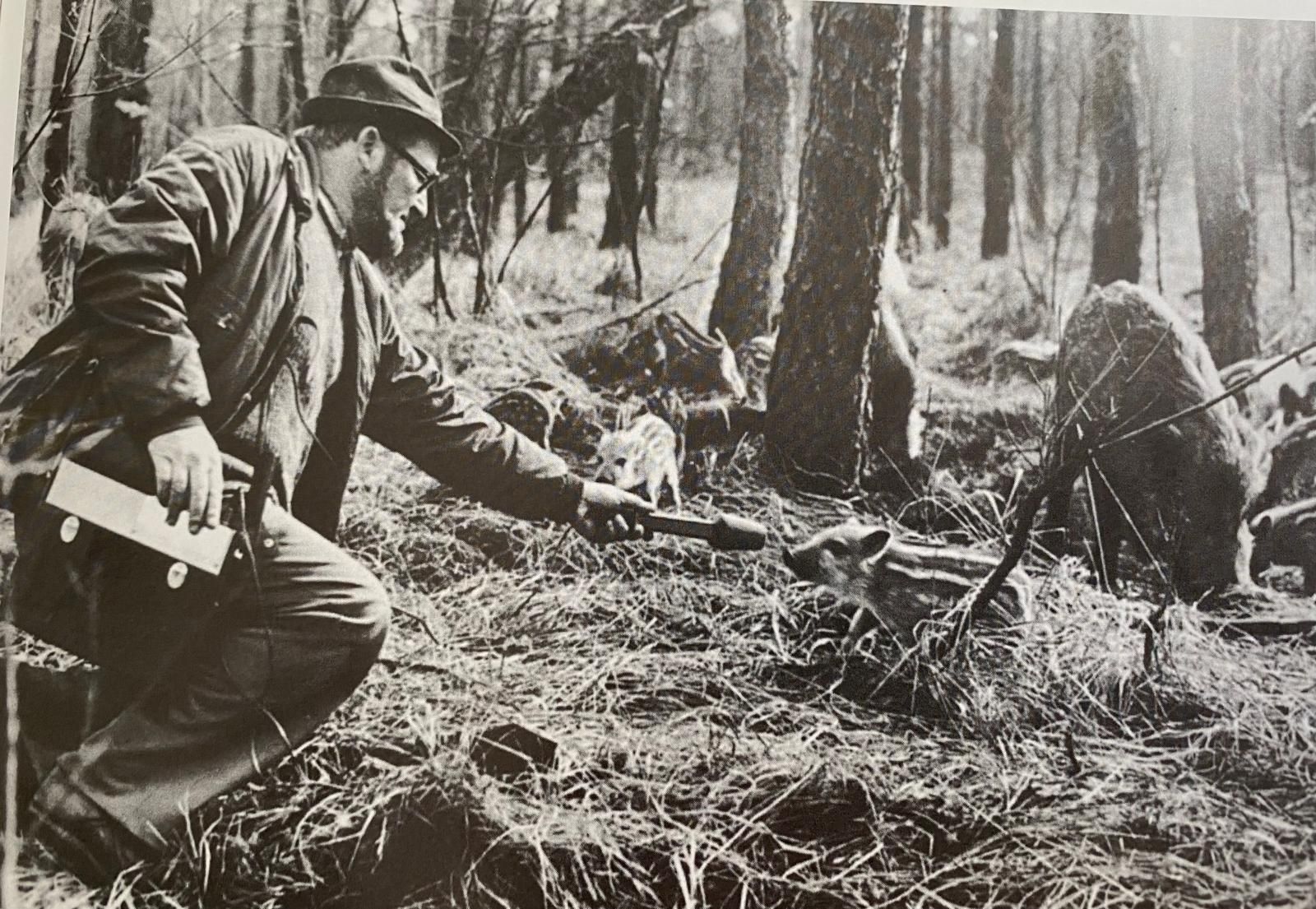
Meynhardt recording the vocal inventory of a piglet.
This laid the base of his success: he wrote seven books on his wild boar research, starting with Schwarzwild-Report. Mein Leben unter Wildschweinen in 1978 – which saw its ninth edition in 2013 and was translated into Czech, Hungarian, Russian and French. Heinz travelled widely across Europe, to Tunesia, Tanzania and Australia. In his documentary on chimpanzees, he could even interview his role model Jane Goodall. Keeping up with the latest developments in etiology, but without having a High School diploma, in 1987 he earned a PhD in animal biology from Karl-Marx University Leipzig in 1987.
To finance his research expeditions and documentaries, and to prove their usefulness to the ever suspicious socialist authorities, Heinz never shied away from “societally useful research” for e.g. agricultural cooperatives, the Institute of Forest Sciences Eberswalde or the Research Center for Animal Production in Dummerstorf-Rostock. For instance, in 1978 he researched which potato varieties pigs preferred, to organise more efficient distraction feeding (Die Stadt Burg und ihr »Wildschwein ehrenhalber«.
Heinz would lay out specimen of two-to-three potato varieties in front of the sounder and observe its behaviour. First the hungry pigs seemed to eat everything. Second, when all were well-fed, they showed strong preferences for certain varietals. However, third, in the matriarchal hierarchy of the sounder, the leading sows tended to eat the preferred tubers, while the junior pigs cleared up the rest. Once he controlled for these three factors, the results became conclusive: the wild boars of Burg loved varieties such as “Adretta”, preferring even its rotten leftover tubers over fresh, but starchy “Astilla” (see Meynhardt erforschte nicht nur Schweine).
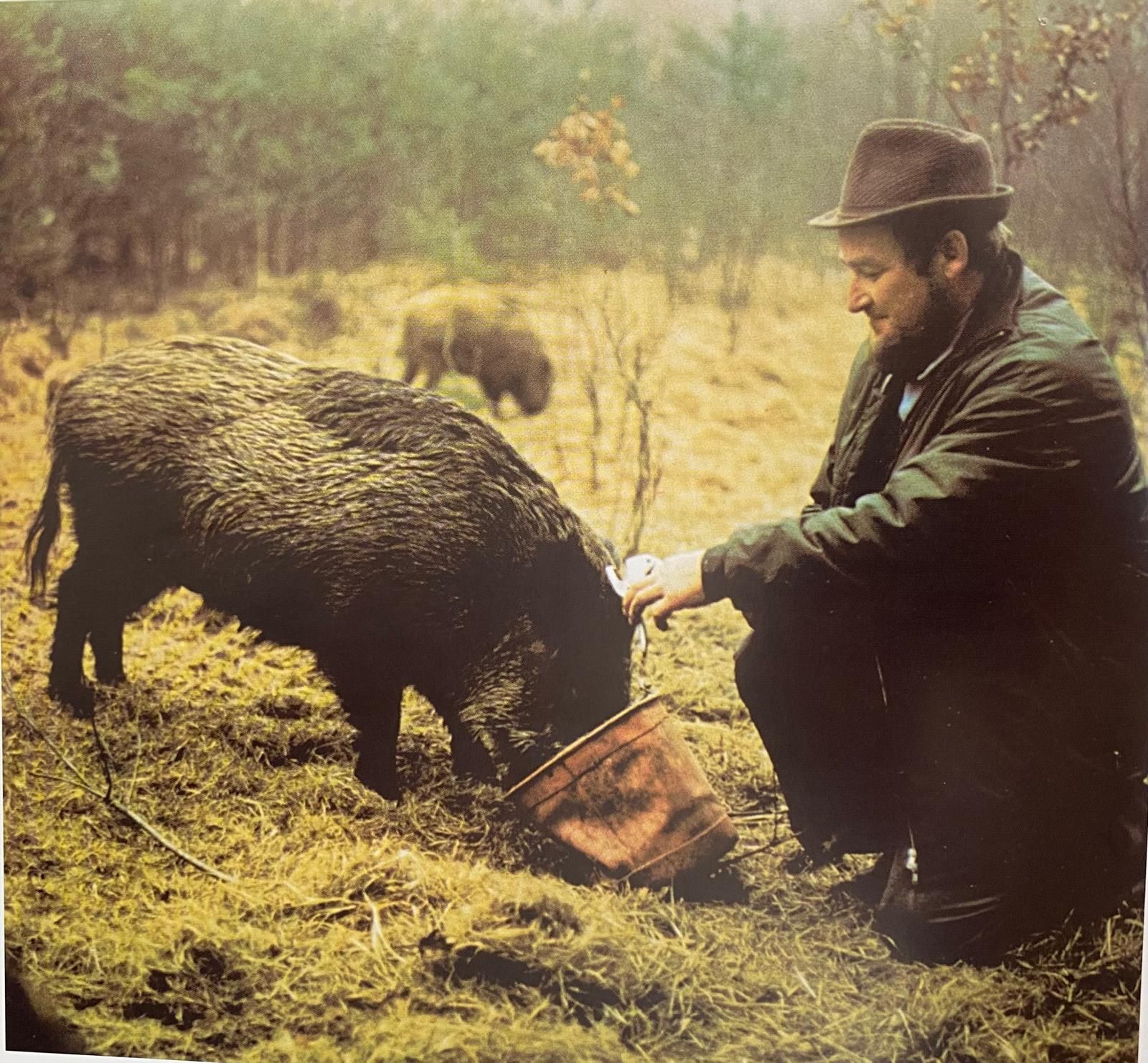
Meynhardt marking a wild pig.
“Schweine-Meynhardt” was renowned for his sympathetic portrayal of wild boar as highly intelligent and sociable. That put him often into a double-bind. For instance, overemphasizing the porcine discerning taste for foodstuffs that humans also appreciated could unwittingly raise the hunting pressure. To date, Meynhardt’s legacy has not been fully researched. It has been preserved by the friendship association Dr. Heinz Meynhardt in Burg; his recordings were collected by the Animal Sound Archiv, Berlin and especially the Saxon State Archives, Leipzig.