Revaluing Patchy Ingredients
Learning requires feeding from all kinds of places
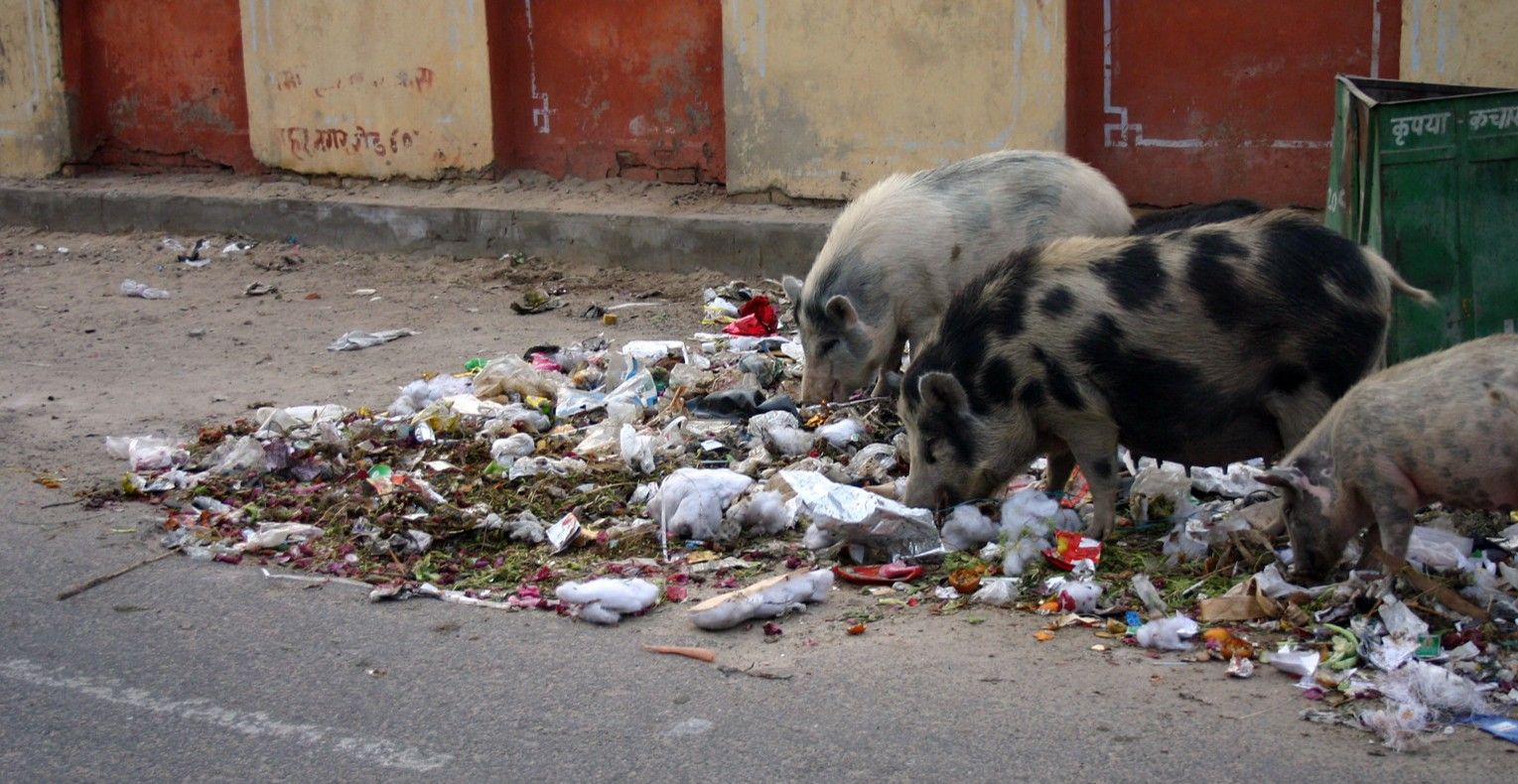
Kept pigs eating trash in the street, Jaipur, India. (Photo: Counterclockwise via Flickr)
Pigs have omnivorous and opportunistic appetites. They are guided by snouts which probe, prod, feel and smell potential foods - from rubbish to grain, flowers to carcasses, roots to baby lambs. Hogs and swillers are often positioned as the opposite of gourmands and connoisseurs but the truth is rootling pigs express an adaptable variety of dining habits and tastes.
Science valorises peer-reviewed papers, the formalised presentation of data and clear methods delineating formulated questions and the validation of results. Yet, the general development of ideas and research processes often emerge through “ill-fitting ingredients” 1 which are commonly written out of, or discounted, from academic outputs: perhaps for being too informal, haphazard, crude, or anecdotal.
Thinking through rootling helps us re-evaluate and embrace the breadth of sources, inspiration and affects we/the sounder draw upon when doing research.
In praise of trash
The pig’s broad palate was reflected in a variety of content members of the BOAR team shared in the social media group chat. Dispersed and isolated over different countries, particularly during the Covid pandemic, the chat app became a critical platform through which we shared pig-related content, including random memes, news reports, anecdotal observations, Instagram videos, or biological papers. Basically, anything!
These posts were often the result of our individual rootling paths - our curious exploratory forays into porcine behaviour, ecologies, material and social relations with humans. ROOTLING/The rootling place is reflective of the diverse ways in which intrigue arose, discoveries communicated, and knowledge collectively distributed. Despite the nature of these sources that some might consider trashy, tasteless, unorthodox, and even disrespectable, we felt obliged to take them seriously as they were critical to our work and collaboration.
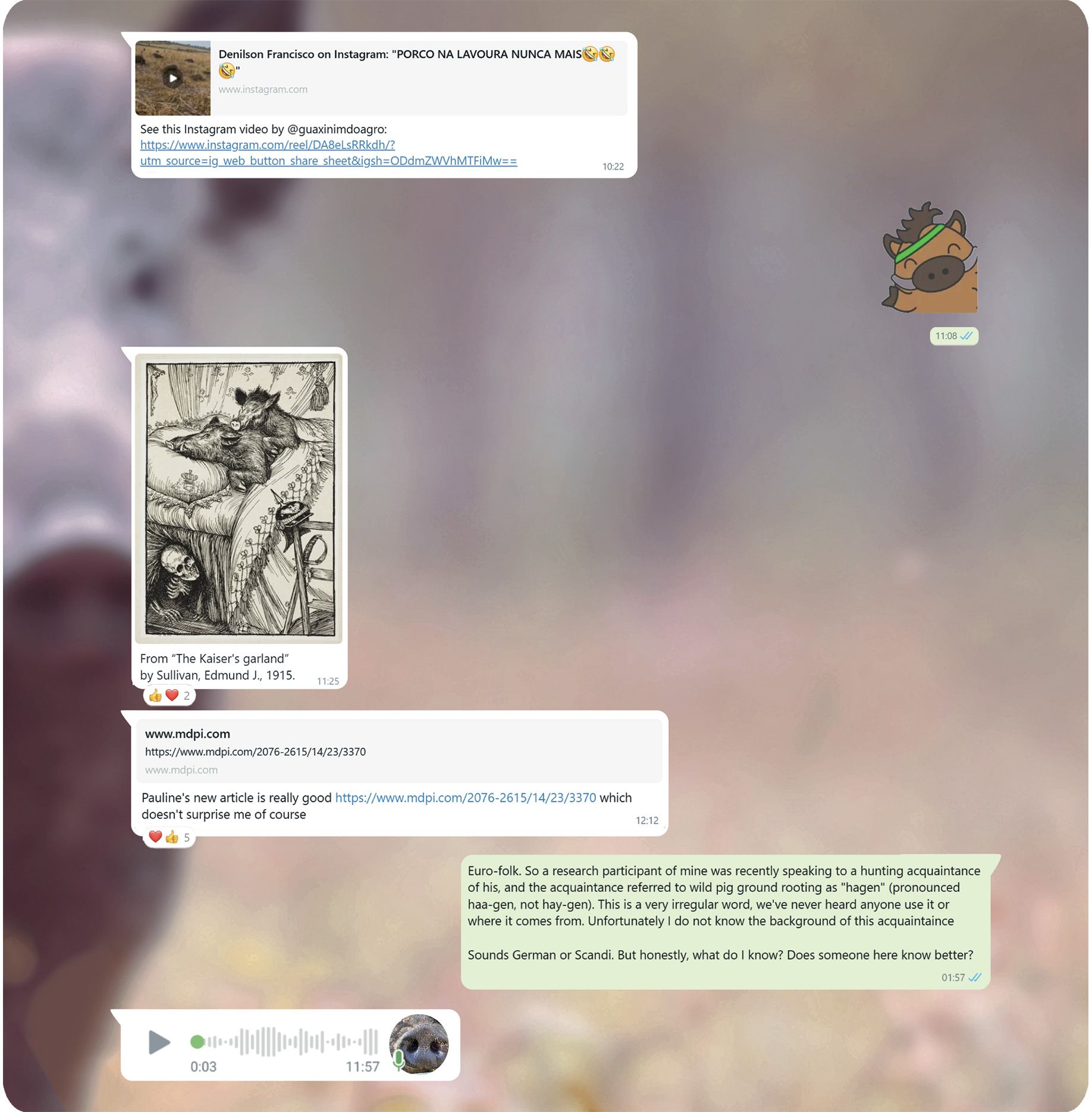
Representation of a group chat
This social media platform was a playful arena where academic rules surrounding rigorously researched sources and serious thinking didn’t necessarily apply. The only rule was self-imposed: we could only post about pigs. 2 Despite this restriction, their plurality helped forge a space that was ever stimulating, surprising, and heterogeneous. Posts were sometimes contradictory, befuddling, and inevitably teased at the rules of who pigs are.
Some posts were “junk food” for laughs and likes. Others demanded thoughtful engagement, invited dialogue and opened colleagues to unexpected inquiries. Some interactions were brief and prompted minimal interaction (you might be left pondering, ‘do none of my colleagues care about this weird pig painting I just discovered?!!’), while others inspired a thread of artisanal responses that developed dialogically into themes.
Banal and frivolous from the outside, the group chat actually became an important and generous space through which the project’s ideas playfully took shape. The rootling place, in some regards, is a public-facing reflection of the multifaceted porcine portrait that emerged over time through this social media platform. Whatsapp gave space to help develop a theory of pigs.
Patchwork pigs
Such background activities are a vital yet often overlooked and devalued part of scientific practice. These are often written out of outputs as an unspoken “hinterland”, or else merely seen as complementary research processes rather than integral ones 3. Compared to peer-reviewed articles and scientific reports, or undertaking carefully planned and conducted research, these less formal sources of learning are commonly disregarded in the doing of science.
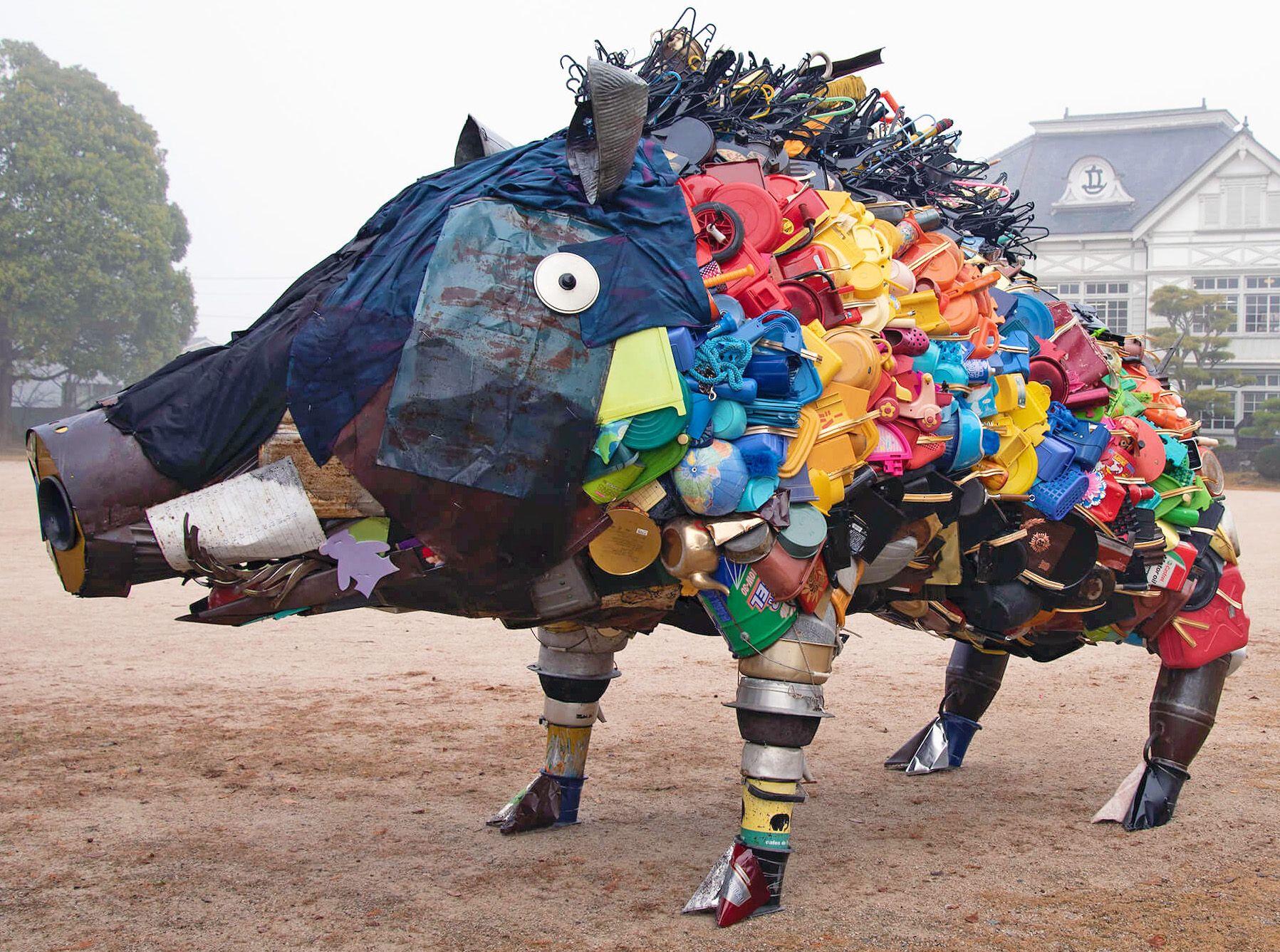
An example of a patchwork pig - The Boar of Maniwa © ︎ Yodogawa Technique Courtesy of YUKARI ART
And yet, acknowledging these resources and how they contribute to the broader process of thinking would seem like a collegial, honest and, frankly, more intriguing approach to academic accounts. Thinking through rootling encouraged us to follow our noses, and leap between different modalities and epistemologies. It reminded us to pay attention to and appreciate all the unequal elements that contribute in significant and minor ways to our thinking. In doing so we co-opt Donna Haraway’s question and think about whom and what do we touch when we touch a particular pig, and the motley crowd that composes and makes possible such encounters.4
Wandering this website, you can weave together various forms of content, from scientific papers to historical accounts, from advertisements to artwork, from news reports to ethnographic anecdotes. Some content is superficially charming and can be quickly consumed; other content is more in-depth and to be digested slowly. Joyful, silly gifs might nudge meaningful, affective memories; deep-dive essays might prompt tangential thoughts. All of this, together, is part of a potential process that “trace[s] connections” 5 between the things that facilitate the emergence of your own insights and theory about pigs.
Plotlessly rootling through these heterogenous and ill-fitting and disparate ingredients helps stitch a patchworked portrait of a pig. A Large Language Model tells us that patchwork “can refer to a specific craft involving sewing fabric scraps, or more broadly, to anything that is a diverse and often varied collection of different components.” 6 A patchwork pig is an appropriate name for the eclectic figure that is weaved together and emerges from the rootling process.
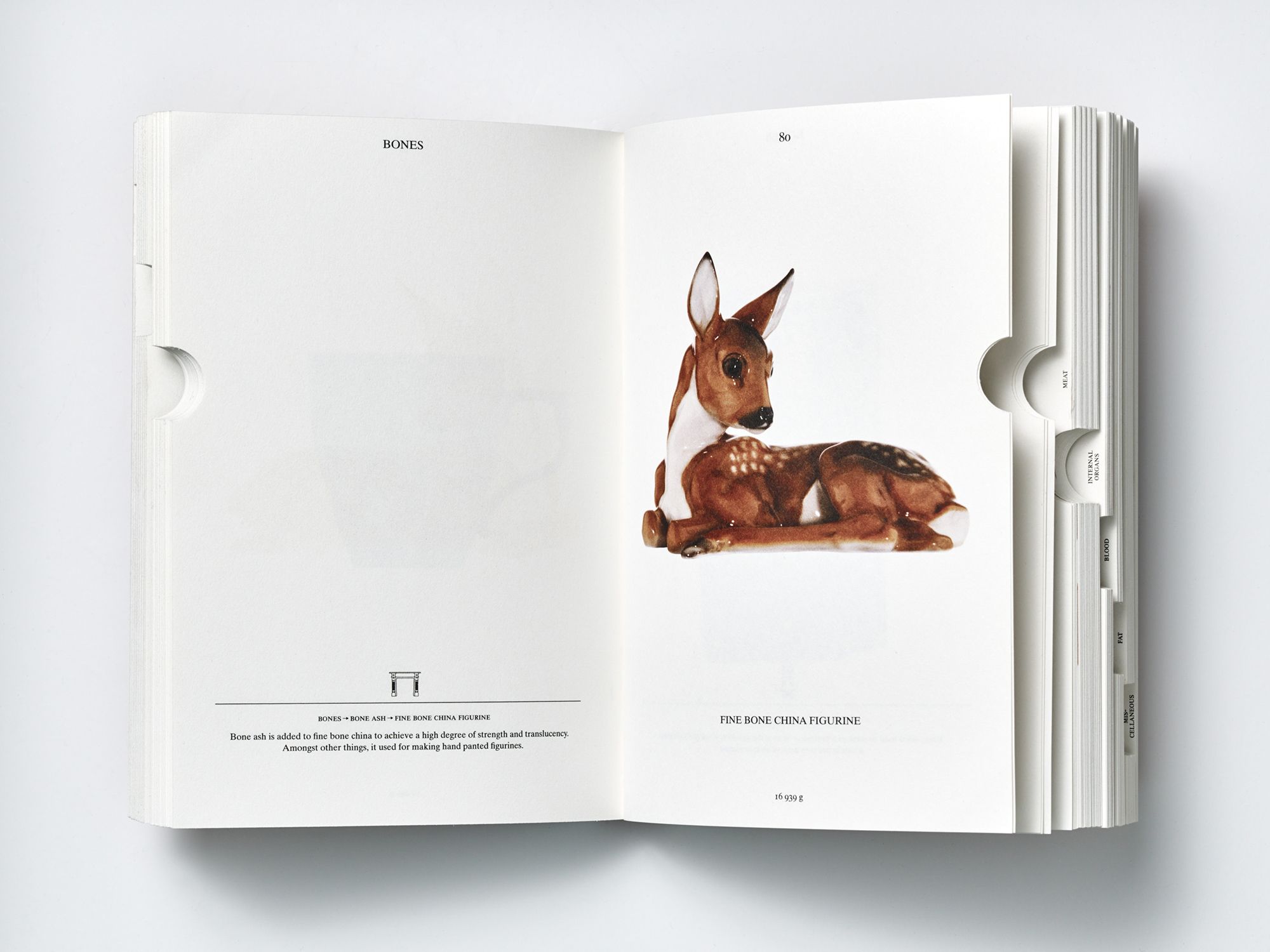
"[Pig] Bone ash is added to fine bone china to achieve a high degree of strength and translucency PIG 05049 © Christien Meindertsma
Other researchers have recently threaded the term "patchwork" or "patchy" and its meanings into our conceptual repertoire, so helping us to make sense of rootling. Anna Tsing, Andrew Mathews and Nils Bubandt have drawn our attention to the patchy Anthropocene and the contextual specificities and unevenness of multispecies configurations and hope across landscapes.7 "Patchwork ethnography" is a methodological manifesto announced by Gökçe Gunel, Saiba Varma, and Chika Watanabe: a reworking of ethnographic approaches through a feminist concept that “expands what we consider acceptable materials, tools, and objects of our analyses” and advocates for a more practical, less rigid, and kinder approach to research.8 This methodological revision in particular resonates with our concept of rootling and the ways we have cobbled together an understanding of swine overtime.
The figure of a patchwork pig pre-existed our naming it; we already encountered it in different forms without immediately recognising it. Writing this post, we suddenly remember the ‘Boar of Maniwa’, an ambivalent and ghostly figure pieced together by various discarded items. We are then sent reeling over our new appreciation of Christien Meindertsma's ‘Pig 05049’ - a document of an individual unmade and redistributed in a capitalist system, and so violently made patchy. Finally, we recall our encounters with environments terraformed by pigs, recognizing how their persistent rootling unevenly churns and reconfigures the landscape's ecologies and aesthetics over time.
The eclectic nature of inspiration and insight can become obscured in formalised scientific accounts. Taking these formal requirments literally and only acknowledging certain forms of knowledge means that a playful approach to doing science is also diminished. As Johan Huizinga notes in his book Homo Ludens (the Playing Human)9:
we might say that modern science, so long as it adheres to the strict demands of accuracy and veracity, is far less liable to fall into play.
This is not to say we disregard "facts" or the need for thoughtful and informed interpretation - these are absolutely essential for trusting sources and reaching valid findings. Rather we believe in balance and the need to occasionally be silly, be aesthetic, to think with and through unorthodox sources, and be open about these engagements. And in doing so foster alternative and insightful forms of research that might lead to unexpected perspectives and outcomes.
Footnotes
-
Law, J., 2004. After Method: Mess in social science research. Routledge. ↩
-
Or at least tusked, trunked mammals, which sometimes meant elephants did sneak in! ↩
-
Law, J., 2004. After Method: Mess in social science research. Routledge. ↩
-
Haraway, D. 2008. When Species Meet. Minnesota: University of Minnesota Press. ↩
-
Latour, B. 2005. _Reassembling the Social. An introduction to actor network theory. _Oxford University Press: New York. ↩
-
Google Gemini - Large language models are themselves analogous to a patchwork process: their answers are forms emerging from diverse sources. ↩
-
Tsing, A.L., Mathews, A.S. & Bubandt, N., 2019. "Patchy Anthropocene: Landscape structure, multispecies history, and the retooling of anthropology: An introduction to supplement 20." Current Anthropology, 60(S20): S186-S197. ↩
-
Watanabe, C., Varma, S. & Günel, G., 2020. A manifesto for patchwork ethnography. Cultural Anthropology.](https://www.culanth.org/fieldsights/a-manifesto-for-patchwork-ethnography) ↩
-
Huizinga, J. 1949. Homo Ludens. Routledge & Kegan Paul: London ↩