CLOSE

Lumpy, A Transient Neighbour

By Kieran O'Mahony
Article thumbnail

Who are wild boar? How can we understand animals commonly imagined as populations or collectives? Or individuals that seem indistinguishable to the human eye?

5 minute read

Early June, 2021, and I’m on an early evening run, a gentle cruise along forestry tracks near the western edge of the Forest of Dean, England. To my left, a dense, gloomy stand of Douglas fir - a ubiquitous conifer planted locally for timber production - stands tall overhead. And to my right, a thinner stand disappears down an escarpment. The sun is still bright, but the trees cast deep shade along the hard, gravel path.

Ahead of me, I notice a dog off the lead, so slow to a walk. She is obedient and seems friendly as I approach, which is not always the case. Commenting on her behaviour, I start chatting to her human companion. Exchanging pleasantries, the topic moves to the boar: ‘Seen any about?’, ‘How is your dog when they meet?’- this kind of patter.

Her response surprises me, partly because I’d recently seen only one boar, and that a fleeting glimpse at dusk, in the weeks since moving to a small cottage beside the woods: “Funnily enough, just a couple of days ago, around this time, I saw a group of at least 20!” Wow! Really? “Not far from here, down the track a bit. I turned the bend and there they were, heading into the trees. One of them had a funny thing on its side - a lump or something. Looked very strange.”

Running home and over the next few days, I kept replaying the story. Perhaps there really were more than 20 in the group. I’d seen large extended sounders - often comprising several sows, presumably mothers and sisters, with their litters – before as they temporarily gather to forage, rest and live together. On the other hand, local controversies around the boar can mean such accounts need to treated cautiously - numbers become exaggerated, feeding narratives that the animals are ‘out of control’. But I was also curious about the sow with lump. I wonder if I'd meet her, and notice her standing out among the others?

Several weeks later, I got my answer.

Since moving to the area, I’d been scoping it out - trying to make sense of my ‘patch’ (the term local naturalists and residents often use for the places they come to know intimately) and how it was inhabited and made by boar. I’d placed several trail cameras at locations marked by their traces, and sketched well-trodden paths and points of significance to the local boar community: wallows, rubbing trees, patches of rootling etc.

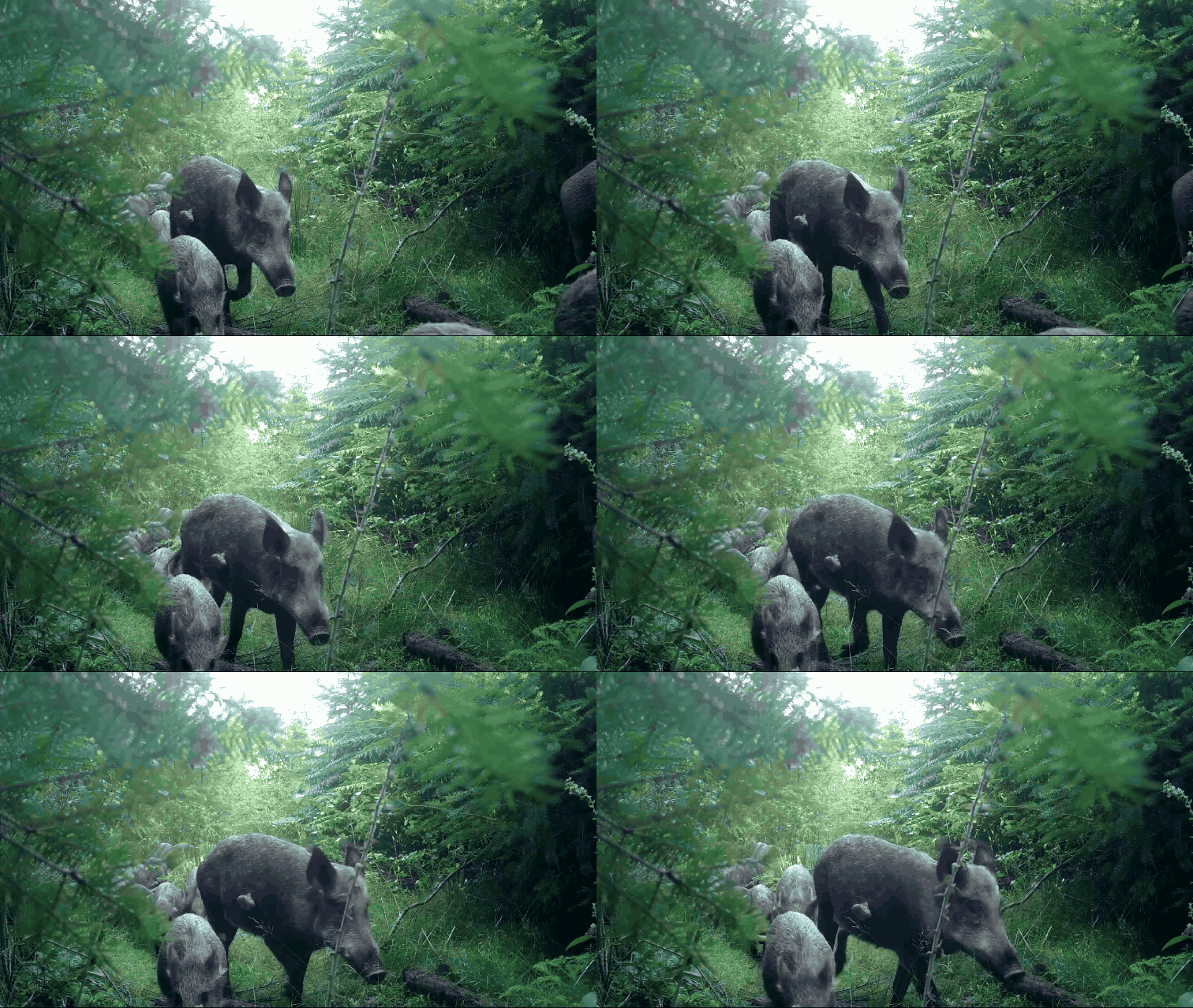
On one camera, pointing down a narrow trail cut through dense regeneration and scrub, a procession appeared: a group of boar, 25 strong. And then, confirmation - the sow with the lump, her strange growth dangling from her right side. Among the other sows, whose differences I found hard to discern, she stood out: Lumpy.

Over several months, she reappeared regularly on the same camera and others nearby. Her growth- a vet suggested it was likely a benign tumour- made her recognizable as an individual. But she also helped tell a story about how these animals behaved, interacted and moved through the Forest landscape, co-producing it anew. In mid-September, a time when the boar habitually venture beyond the woodland to forage in the grasslands around local settlements, she appeared outside my house. This time, without her large family but a smaller group of juveniles, presumably her own young.

Mid-2022. I hadn’t seen Lumpy for many months. Even though I regularly encountered other boar – on foot and through cameras - she had vanished. I occasionally bumped into the dog walker I’d met that first day and sometimes asked, but she hadn’t seen her either. Most likely, we presumed, she’d been shot by a forestry ranger as part of the local cull. The thought hung heavy.

And then, one evening at the beginning of June, there she was, nosing around at a local wallow. Last year’s young were gone, replaced by a new litter of striped ‘humbugs’. They remained in this patch for several more months, occasionally joined by other grown females – most likely her older daughters. And then, after passing a camera for the last time in October, she disappeared once again, this time without return. I continued to encounter other boar, but Lumpy had gone.

Animals such as pigs and wild boar are often reduced to populations and collectives. Their individuality and personalities are subsumed by their abundance and physiological similarity. This is partially a methodological problem, but it is also ontological: it positions boar in a particular way. Recognising Lumpy – through her appearances, disappearances, habits and social rhythms - opened a more nuanced story: one in which boar life is less anonymous, and more-than-human worlds feel textured and thick.

Scholars have noted that attending to individual animals doesn’t necessarily humanise them, but helps reveal how individuality itself is relationally produced - through encounters, technologies, and landscapes.1 Lumpy, and her unusual growth, offered a glimpse at that relational individuality: a sow who connected lives and stories, and ways of knowing place.

Cite this entry as...

O'Mahony K (2025). 'Lumpy, A Transient Neighbour'. In Keil, P.G., O'Mahony, K., Szczygielska, M., Kuen, L., Raju, S. & Sarapuu, J. (eds.), ROOTLING (https://rootling.place). Karolinum Press: Prague. https://rootling.place/articles/Lumpy-transient-neighbour

Footnotes

  1. Bear, C. (2011). Being Angelica? Exploring individual animal geographies. Area, 43(3), 297-304; Van Patter, L. E. (2022). Individual animal geographies for the more-than-human city: Storying synanthropy and cynanthropy with urban coyotes. Environment and Planning E: Nature and Space, 5(4), 2216-2239.